
Why Is My Cake Dense? 7 Common Causes & Fixes
Stop guessing – diagnose your cake problems like a pro
You followed the recipe. You measured everything. You waited for the oven to preheat. But when you pulled the cake out, it looked more like a brick than a cloud. Dense, heavy, maybe even gummy.
It happens to everyone – even experienced bakers. The good news? Almost every case of a dense cake comes down to one of seven specific causes. Once you know which one, the fix is simple.
Let’s troubleshoot your cake, step by step.
🕵️ The 7 Culprits (And How to Fix Each)
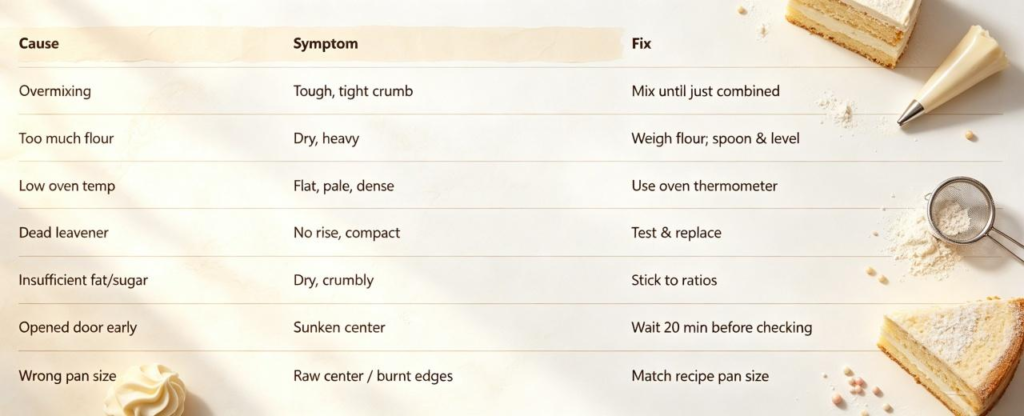
1. Overmixing the Batter
This is the #1 cause of dense cakes. When you mix flour with liquid, gluten develops. The more you mix, the tougher the cake.
Fix: Mix until just combined – stop when you no longer see streaks of flour. Use a rubber spatula for the final folds, not an electric mixer.
2. Wrong Flour / Too Much Flour
Different flours have different protein levels. Cake flour (low protein) gives tenderness. All-purpose is fine, but if you scoop with the measuring cup, you can pack in 20% more flour than intended.
Fix: Use a digital scale for accuracy. If using cups, spoon flour into the cup and level off – don’t scoop.
3. Oven Temperature Too Low
A cake needs a hot initial blast to set the structure. If the oven runs cool, the batter spreads before the structure sets, leading to a dense, flat cake.
Fix: Use an oven thermometer. Many home ovens are 25°F (14°C) off. Pre-heat fully – at least 20 minutes.
5. Too Little Fat or Sugar
Fat tenderizes the crumb; sugar aerates when creamed. Cutting either reduces lightness.
Fix: Follow the recipe ratios. Substitutions (e.g., applesauce for oil) can work but change the structure – research first.
6. Opening the Oven Door Too Early
Cold air rushes in, causing the cake to collapse before the structure sets. This is especially critical in the first 20 minutes.
Fix: Resist the urge. Use the oven light to check. If you must peek, do it after at least ⅔ of the bake time.
7. Pan Size Mismatch
Using a larger pan than specified makes the batter too shallow – it bakes too quickly and dries out. Using a smaller pan makes it too thick – the center stays raw while the edges burn.
Fix: Stick to the pan size in the recipe. If you must change, adjust bake time (smaller pan = longer, larger pan = shorter).
🛠️ How Your Baking Mat Helps
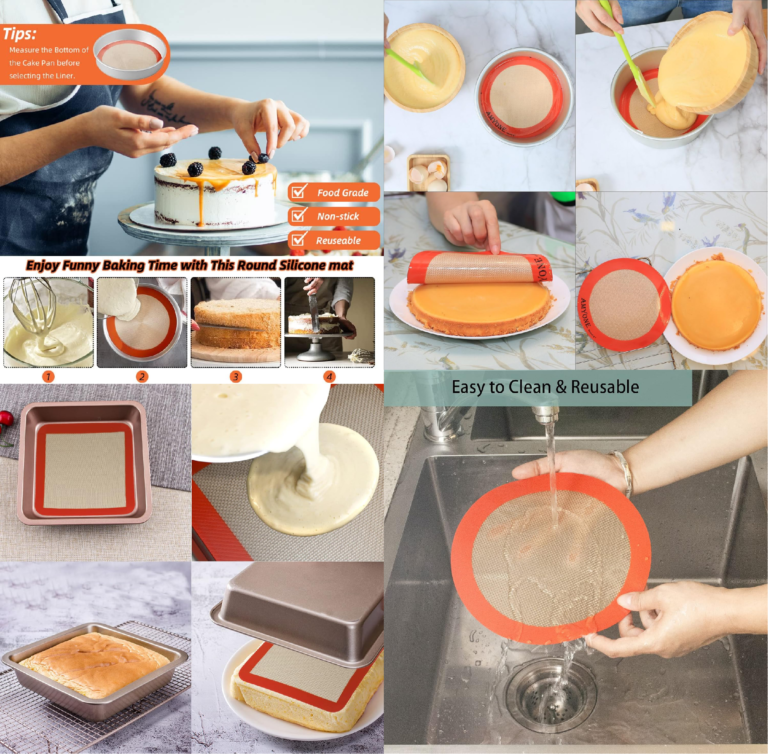
You might wonder: what does a silicone baking mat have to do with cake density? More than you’d think.
Three ways a mat saves your cake:
- Even heat distribution – A mat on the baking sheet prevents hot spots that cause uneven baking. Place your cake pan on the mat (instead of directly on the rack) to diffuse heat.
- Easy removal of sticky batters – If you line the bottom of your cake pan with a circle cut from a silicone mat, the cake releases perfectly – no tearing, no crumbling.
- Cleaner testing – When you invert a cake onto a mat to cool, it won’t stick. No lost crumbs.
Pro tip: For delicate cakes like chiffon, invert the pan onto a cooling rack placed over a silicone mat – the mat catches any drips and protects your counter.
Bake with confidence. Our silicone baking mat helps you get consistent results by distributing heat evenly and preventing sticking. Perfect for lining pans or cooling cakes. See how it works →
Frequently asked questions
Why is my cake dense but not dry?
Likely overmixing or old leavener. The gluten tightened the crumb, but moisture is still there. Try mixing less and checking your baking powder.
Can I fix a dense cake after baking?
Not really – but you can repurpose it. Cube it for trifle, blitz into cake pops, or toast for ice cream topping.
Does altitude affect cake density?
Yes. At high altitudes (above 3000 ft / 900 m), reduced air pressure causes cakes to rise too fast and collapse. Adjustments include reducing sugar and increasing flour.
Should I use a metal or glass pan for even baking?
Metal pans (light-colored) conduct heat best. Glass takes longer to heat and retains heat longer, which can lead to over-browned edges and a dense center.
The Bottom Line
A dense cake isn’t a failure – it’s feedback. Every dry bite tells you something about your technique, your ingredients, or your oven. Once you learn to read that feedback, you’ll never guess again.
Start with the simplest fix: check your oven temperature. Then check your mixing method. Then check your leavener. Nine times out of ten, one of those three is the culprit.
And remember: even a “failed” cake tastes pretty good with a scoop of ice cream on top.